
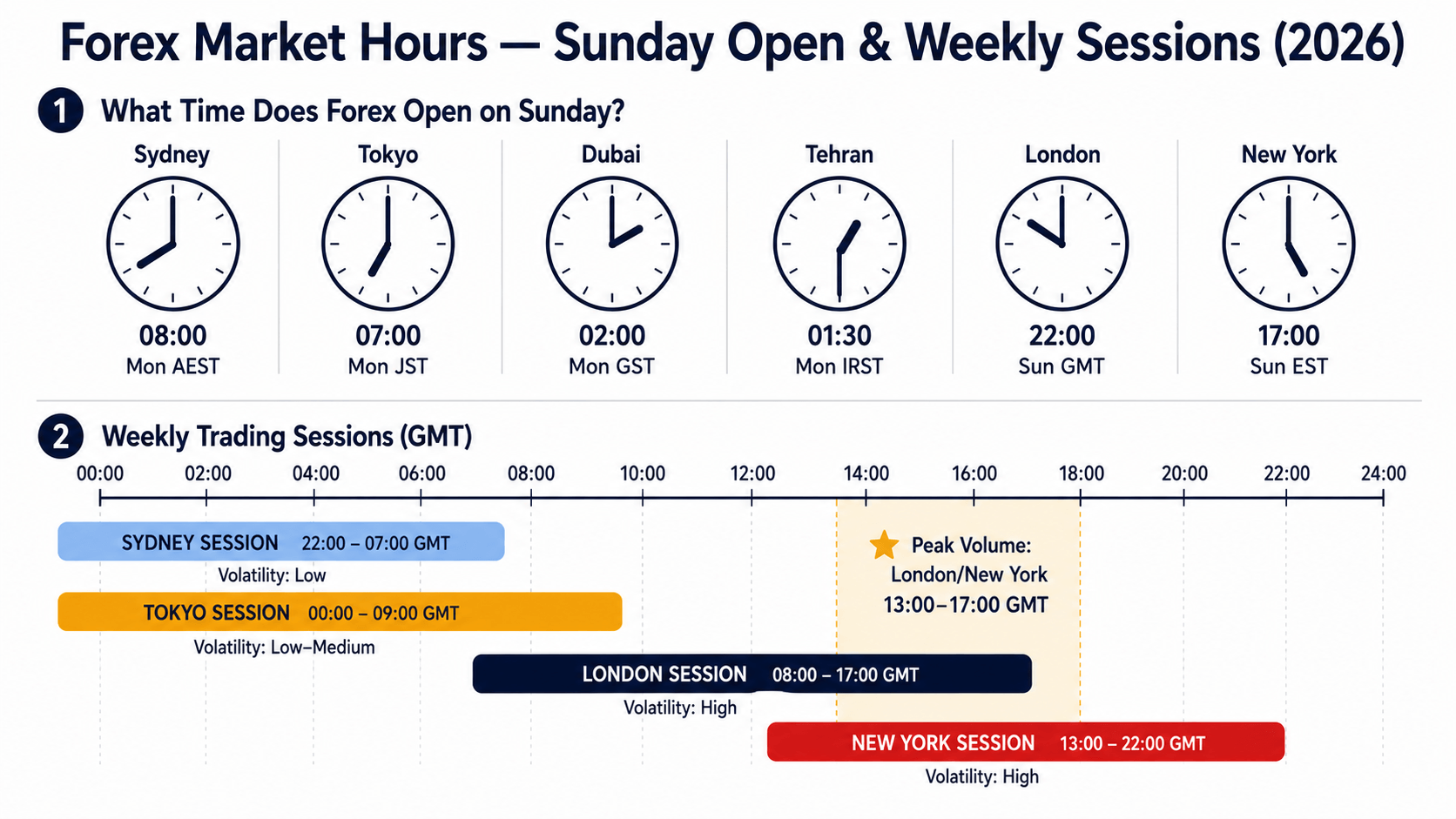
The forex market opens on Sunday at 22:00 GMT (5:00 PM EST) when the Sydney session begins, marking the start of a new trading week. This Sunday open is one of the most important moments on the forex calendar — it is when prices first react to any news, geopolitical events, or economic developments that occurred while markets were closed over the weekend.
Unlike stock exchanges which have fixed opening bells, the forex market is decentralised and operates across multiple time zones simultaneously. Understanding exactly when each session opens — and what happens in the first hours of Sunday trading — is essential knowledge for any trader planning their week.
In this guide — updated for 2026 — we cover the exact Sunday opening times in GMT, EST, and other key time zones, how each trading session works, what causes weekend gaps, how to trade the Sunday open safely, and how the Asia session specifically affects currency pairs and volatility.
What Time Does the Forex Market Open on Sunday?
The forex market opens on Sunday at the following times depending on your time zone:
| Time Zone | Sunday Open Time | City Reference |
|---|---|---|
| GMT (UTC+0) | 22:00 Sunday | London (winter) |
| EST (UTC-5) | 17:00 Sunday | New York |
| CET (UTC+1) | 23:00 Sunday | Frankfurt, Paris |
| MSK (UTC+3) | 01:00 Monday | Moscow |
| GST (UTC+4) | 02:00 Monday | Dubai |
| IST (UTC+5:30) | 03:30 Monday | Mumbai |
| IRST (UTC+3:30) | 01:30 Monday | Tehran |
| AEST (UTC+10) | 08:00 Monday | Sydney |
| JST (UTC+9) | 07:00 Monday | Tokyo |
The Four Forex Trading Sessions — Full Schedule (2026)
The forex market operates through four major trading sessions that open sequentially and overlap, creating a continuous 24-hour market from Sunday evening to Friday evening GMT.
| Session | Open (GMT) | Close (GMT) | Key Currencies | Typical Volatility |
|---|---|---|---|---|
| Sydney | 22:00 Sun | 07:00 Mon | AUD, NZD | Low |
| Tokyo (Asia) | 00:00 Mon | 09:00 Mon | JPY, AUD, CNH | Low–Medium |
| London (Europe) | 08:00 Mon | 17:00 Mon | EUR, GBP, CHF | High |
| New York (US) | 13:00 Mon | 22:00 Mon | USD, CAD, MXN | High |
The trading week effectively begins with the Sydney session on Sunday evening GMT and ends with the New York session close on Friday at 22:00 GMT — giving traders approximately 120 continuous hours of market access each week.
Asia Session Time — What Traders Need to Know
The Asia session — combining the Sydney and Tokyo sessions — is the first major period of forex activity each week. It runs from approximately 22:00 GMT Sunday to 09:00 GMT Monday, with the Tokyo session (00:00–09:00 GMT) being the more active of the two.
Asia Session Characteristics
- Lower overall volatility compared to London and New York — price ranges are typically 30–50% smaller than during European trading hours
- JPY pairs most active: USD/JPY, EUR/JPY, GBP/JPY see their highest relative volume during Tokyo hours
- AUD and NZD pairs move during Sydney: Australian and New Zealand economic data releases fall in this window
- Range-bound price action: Many currency pairs trade within tight ranges during the Asia session, making range trading and support/resistance strategies effective
- Key data releases: Japanese economic indicators (CPI, trade balance, Tankan survey), Australian employment data, Chinese PMI figures all fall during Asia session hours
Asia Session Time by Time Zone
| Time Zone | Tokyo Session Start | Tokyo Session End |
|---|---|---|
| GMT (UTC+0) | 00:00 | 09:00 |
| EST (UTC-5) | 19:00 (prev. day) | 04:00 |
| CET (UTC+1) | 01:00 | 10:00 |
| GST (UTC+4) | 04:00 | 13:00 |
| IRST (UTC+3:30) | 03:30 | 12:30 |
| JST (UTC+9) | 09:00 | 18:00 |
| AEST (UTC+10) | 10:00 | 19:00 |
Forex activity across Asia has grown significantly in recent years. Japan remains the third-largest forex market globally, while emerging economies across the region are seeing rapid growth in retail trading participation. For more on regional forex trends see our article on forex growth in Japan, Iran, and Mongolia.
Trading Session Overlaps — The Most Important Windows
Session overlaps occur when two major financial centres are simultaneously open. These periods generate the highest volume, tightest spreads, and largest price moves of the trading day.
| Overlap | GMT Time | EST Time | Characteristics |
|---|---|---|---|
| Sydney / Tokyo | 00:00 – 07:00 | 19:00 – 02:00 | Moderate — AUD/JPY most active |
| Tokyo / London | 08:00 – 09:00 | 03:00 – 04:00 | Brief — EUR/JPY spikes common |
| London / New York ⭐ | 13:00 – 17:00 | 08:00 – 12:00 | Highest volume of the week — all majors |
The London/New York overlap (13:00–17:00 GMT) accounts for approximately 50–70% of the total daily forex volume on major pairs. Most institutional traders and algorithmic systems concentrate activity during this window. Major US economic data releases — NFP, CPI, FOMC statements — almost always fall during this overlap.
The Forex Weekend Gap — What It Is and How to Manage It
A weekend gap occurs when the forex market opens on Sunday at a significantly different price from where it closed on Friday. Because markets are closed from Friday 22:00 GMT to Sunday 22:00 GMT, any news — geopolitical events, natural disasters, political announcements, central bank statements — that occurs over the weekend is immediately priced in at the Sunday open, creating a price gap.
Common Causes of Weekend Gaps
- Surprise central bank announcements or emergency rate decisions
- Geopolitical crises — wars, sanctions, political coups
- Major economic data released during weekend hours
- Natural disasters affecting major economies
- Cryptocurrency market moves (crypto trades 24/7 and can signal sentiment for Sunday open)
How to Manage Weekend Gap Risk
- Close positions before Friday close if you cannot accept gap risk — especially ahead of known risk events over the weekend
- Reduce position size on any trades held over the weekend
- Use guaranteed stop-losses if your broker offers them — standard stop-losses do not protect against gaps (price skips past the level)
- Wait for the gap to partially fill before trading on Sunday — many weekend gaps partially or fully fill within the first hours of the new week as the initial overreaction normalises
- Monitor crypto and futures markets on Sunday afternoon before the open — they can signal the direction and magnitude of the anticipated gap
How to Trade the Sunday Forex Open — Practical Tips
- Check the economic calendar before Sunday open. Know what data is scheduled for the week ahead — especially any Monday Asian session releases from Japan, Australia, or China that could move JPY, AUD, or NZD pairs immediately.
- Assess the weekend news flow. Review major news headlines from Saturday and Sunday before the market opens. Any significant geopolitical or economic development will likely cause a gap or strong directional move at open.
- Watch the gap size before trading. If the market gaps significantly at Sunday open, wait. Many traders rush to trade the gap direction immediately — but the initial move is often an overreaction that partially reverses within the first 1–2 hours.
- Start with lower position sizes on Sunday. Liquidity at the Sydney open is lower than during London or New York hours. Spreads are wider, slippage is higher, and fills can be unpredictable. Reduce size until liquidity normalises.
- Focus on JPY and AUD pairs during Asia session. These are the most active pairs during Sunday evening and early Monday GMT hours. EUR/USD and GBP/USD tend to be range-bound until the London session opens at 08:00 GMT.
Do All Forex Brokers Open at the Same Time on Sunday?
Not exactly. While the interbank forex market officially opens at 22:00 GMT Sunday, individual brokers may open their platforms slightly earlier or later depending on their liquidity providers and server locations. Some key points:
- Most ECN/STP brokers open close to 22:00 GMT Sunday, directly following interbank market hours
- Some market maker brokers may open their platforms at 21:00 or 23:00 GMT depending on their internal pricing model
- Crypto and commodity markets (gold, oil) on some platforms open earlier on Sunday due to different underlying market hours
- Spreads are always wider at Sunday open — regardless of broker type — due to lower liquidity. Expect spreads 2–5x wider than during London session peak hours
Always verify your specific broker’s Sunday opening time directly — check their trading hours page or contact support, especially if you plan to trade the open systematically.
Frequently Asked Questions
What time does the forex market open on Sunday GMT?
The forex market opens on Sunday at 22:00 GMT when the Sydney session begins. This marks the start of the new trading week. In EST (Eastern Standard Time), this is 17:00 (5:00 PM) on Sunday.
What is the Asia session time in forex?
The Tokyo (Asia) session runs from 00:00 to 09:00 GMT, or 19:00 to 04:00 EST. The broader Asian session including Sydney starts earlier at 22:00 GMT Sunday. JPY, AUD, and NZD pairs are most active during this window.
Is forex trading active on Sunday?
Sunday trading is significantly less active than the rest of the week. The first few hours after the 22:00 GMT open (Sydney session) have lower liquidity, wider spreads, and lower volume. Activity picks up notably when Tokyo opens at 00:00 GMT and substantially more when London opens at 08:00 GMT Monday.
What is a forex weekend gap?
A weekend gap occurs when the forex market opens on Sunday at a different price from where it closed on Friday, due to news or events that occurred while markets were closed. Gaps can be bullish (opening higher) or bearish (opening lower) and can range from a few pips to hundreds of pips on major news events.
What is the best time to trade forex during the week?
The London/New York overlap (13:00–17:00 GMT, or 08:00–12:00 EST) is the most active and liquid period of the entire trading week. Most major price moves, economic data releases, and institutional activity concentrate in this four-hour window. For beginners, this is the best session to focus on.
Does the forex market close on weekends?
Yes. The forex market closes at 22:00 GMT on Friday when the New York session ends and reopens at 22:00 GMT on Sunday with the Sydney session. The market is closed for approximately 48 hours over the weekend. Cryptocurrency markets remain open 24/7 including weekends.
New to forex trading? Read our complete beginner’s guide covering currency pairs, leverage, trading strategies, and how to open your first account.

I didn’t know the Forex market opened on Sundays. Good to know for future trading!
This article explains why the market opens on Sunday. Makes sense with global time zones.
Knowing the opening times can help in planning my Forex strategy better. Very informative.
Thanks for breaking down the sessions! I always wondered about Sunday trading.
Understanding volatility on Sundays is crucial. This article highlights important points.
The overlap of sessions seems like a good time to trade due to increased activity.
‘Market gaps’ are something I need to watch out for during Sunday trading!
‘Liquidity and volatility’ during different sessions are key takeaways for me.